Six years after it was built, Whitehorse artist’s Arctic Winter Games cauldron is finally lit
By Gloria Mok
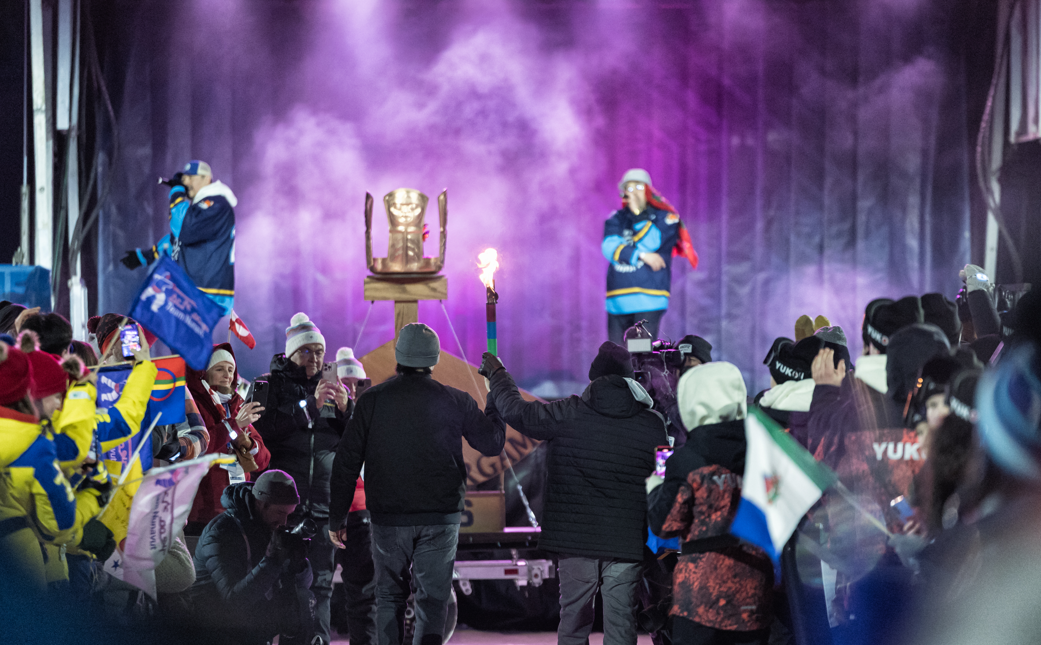
The cauldron prominently featured at Sunday night's Opening Ceremony was designed by local Whitehorse metalworks artist Brian Walker in collaboration with his son, Justin Smith, a moment that has been many years in the making.
“It was wonderful to have it brought on. I even got a little teary eyed,” said Walker when asked to describe how he felt.
Walker originally designed the cauldron for the 2020 Arctic Winter Games, but those games were cancelled due to the COVID-19 pandemic. The 2026 Games in Whitehorse marks the first time the cauldron has been officially lit, though not using its original propane flame due to renewed safety concerns, but rather a glass flame designed by Lumel Studios that is illuminated using electricity, which is much safer.
The cauldron itself is made of copper, a material Walker has been working with as an artist for the past three decades. The cauldron’s unique shape is formed using four tináa (a Tlingit word for copper shield), each facing one of the four sacred directions: East, South, West, North. Each tináa carries a child’s face with a different carefully sculpted expression, inspired by the teachings from each direction.
The story of the cauldron begins with “the child facing East, where the sun rises. The child is not quite awake yet, but is pleasantly dreaming with a smile on their face.”
The child awakens in the South, with “mouth and eyes open, they start to see and express themselves.”
Turning to the West, the child is “fully aware and wide awake with a serious face, because the child is seeing the world and some of the problems that have to be solved.”
“The North symbolizes joy, as the child starts to find solutions to those problems.”
Tináa is also a symbol of wealth. Copper reflects the flesh of the salmon, the wealth of food that sustains the people, which is why many First Nations wear tináa as jewelry. For Walker, the cauldron represents the “development of a human being” that has “an outer and an inner light.” It was designed to “remind people that our children are our wealth,” a meaningful raison d'être for several volunteers, officials, parents, and staff supporting youth at this year’s Arctic Winter Games.
Visit the Canada Games Centre to get a closer look at the cauldron which according to Walker, “brings hope and happiness to people” and “expresses how we all feel about living in the north.”
other Recent updates
Mt. Sima GM invites the Secretary of State for Sport Adam van Koeverden to snowboard, discuss the future of sport tourism in the Yukon

Remarque :
La traduction française du site est générée automatiquement et peut ne pas être totalement exacte.
please note :
French translation on the site is auto generated and may not be fully accurate.
Should there be an issue with the translation, please email info@awg2026.org